



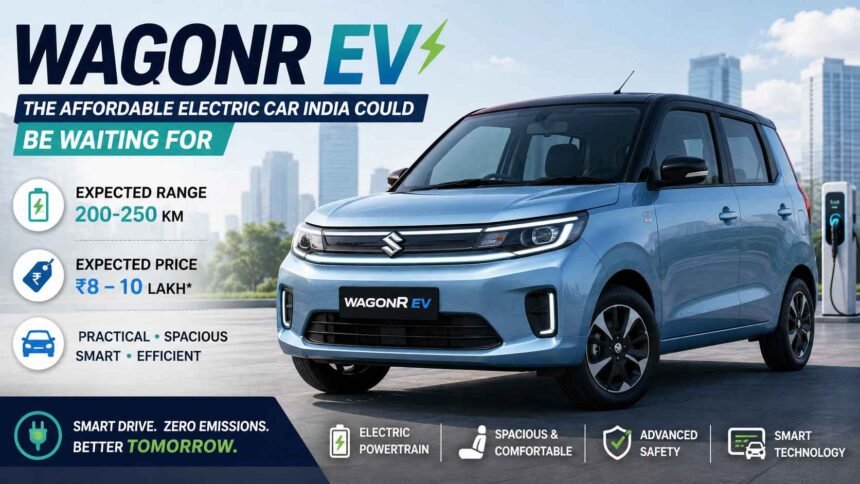
The WagonR EV is one of those electric cars that many Indian buyers have been waiting to see on the road. The reason is simple. The WagonR has been one of Maruti Suzuki’s most practical and popular hatchbacks for years, thanks to its spacious cabin, easy driving experience and relatively affordable running cost.
But there is an important update readers should know before getting too excited. As of August 2026, Maruti Suzuki has not officially launched a production WagonR EV in India. Maruti’s first battery electric vehicle for India is the e VITARA, while the company has also shown small electric concepts that give us an idea of where its future compact EVs could go.
So, what can buyers actually expect from a WagonR EV? Here is a closer look at its possible design, range, features, price and overall potential.
What Is the WagonR EV?
The idea of an electric WagonR is not new. Maruti Suzuki tested electric WagonR prototypes in India several years ago. The company had even showcased an electric WagonR prototype and tested a fleet of vehicles for Indian conditions. However, the original project was shelved in 2022 because the economics of making an affordable electric hatchback were difficult at that time.
Since then, Suzuki has continued developing small electric vehicles. The eWX concept, shown at the Japan Mobility Show 2023, was a mini wagon EV designed around everyday city use. Suzuki quoted a reference range of around 230 km, along with dimensions of 3,395 mm in length, 1,475 mm in width and 1,620 mm in height.
The eWX is not officially the WagonR EV, but its practical mini-wagon approach has naturally created speculation about a future affordable Maruti electric hatchback.
WagonR EV Expected Design
A future WagonR EV could follow the same basic idea that made the petrol WagonR successful: maximum cabin space in a compact body.
Instead of going for an aggressive SUV look, a compact electric Maruti could use a tall-boy design with a clean front end, simple LED lighting and a more modern closed grille area. A shorter bonnet could also help improve cabin space.
The biggest attraction would likely remain practicality. A small turning radius, high seating position and good visibility would make the car particularly suitable for crowded Indian cities.
The final design, however, has not been officially revealed for a WagonR EV, so these points should be treated as expectations rather than confirmed specifications.
Must Read: MG Comet EV Review: Price, Range & Specs
Expected WagonR EV Battery and Range
Range will be one of the biggest talking points.
The earlier electric WagonR prototypes were reported to have a real-world range of around 130 km, but battery technology and EV platforms have improved significantly since then.
Suzuki’s eWX concept had a reference range of about 230 km, showing that the company has been looking at a practical small EV rather than an ultra-short-range city vehicle.
For a production WagonR EV, an expected range of around 200 to 250 km would make more sense for Indian buyers. A range above 250 km would make it even more attractive for users who occasionally travel outside the city.
Of course, the final range will depend on the battery size, weight, motor efficiency, tyre size and driving conditions.
Expected WagonR EV Performance
A small electric hatchback does not need a powerful motor to be useful.
The WagonR EV would likely focus on quick acceleration at low speeds rather than outright performance. That would make it ideal for city traffic, where instant electric torque can make overtaking and gap-filling much easier.
Expect smooth acceleration, quiet operation and a single-speed automatic transmission. Regenerative braking could also help recover some energy when the car slows down.
For daily commuting, this kind of setup could be more enjoyable than a petrol engine, especially in stop-and-go traffic.
WagonR EV Charging
Charging will also play a major role in the car’s success.
A future Maruti electric car in this segment should ideally support both home charging and DC fast charging. Home charging would remain the most convenient option for daily use, while fast charging would be useful during longer trips.
Maruti has already started building its EV ecosystem around the e VITARA, including home charging support and public charging access through its EV platform.
This is a positive sign for future affordable electric models as well.
WagonR EV: Expected Features
The WagonR EV could receive a noticeable upgrade over the regular petrol WagonR in terms of technology.
A likely equipment package could include a touchscreen infotainment system, smartphone connectivity, connected-car functions, digital displays, automatic climate control, push-button start and steering-mounted controls.
Safety should also be an important part of the package. The current petrol WagonR already offers features such as six airbags and electronic stability control in its latest range.
A new EV would ideally bring even stronger standard safety equipment, along with features such as a rear parking camera, ABS with EBD, tyre pressure monitoring and hill-hold assistance.
However, these are expected features and should not be considered confirmed until Maruti announces the production model.
WagonR EV Expected Price in India
Price could decide whether this car becomes a hit or not.
The current petrol WagonR starts at around ₹4.99 lakh ex-showroom, while Maruti’s e VITARA is positioned at a much higher price point.
A future WagonR EV would have to bridge this gap carefully.
Based on current market expectations and the positioning of small electric cars, an estimated WagonR EV price of around ₹8 lakh to ₹10 lakh ex-showroom could make sense. Some reports and automotive platforms have placed expected pricing around this level, but there is no official Maruti price yet.
The biggest challenge for Maruti will be keeping the battery cost under control while still offering a useful range.
WagonR EV Review: Should You Wait?
Based on what we know, the potential of the WagonR EV is quite strong.
Its biggest advantage could be practicality. A compact footprint, roomy cabin and electric powertrain would suit Indian city driving extremely well. Maruti’s huge service network could also give buyers more confidence compared with some newer EV brands.
Another major advantage would be running cost. Charging an EV at home can be considerably cheaper per kilometre than using petrol, depending on electricity rates and daily usage.
But there are also questions.
The biggest concern is the final price. If the car becomes too expensive, buyers may prefer larger EVs with longer range. Battery warranty, boot space, charging speed and highway range will also matter.
There is another important point: this is not a road-test review, because a production WagonR EV is not currently available for a normal consumer test drive. This review is therefore based on Maruti Suzuki’s EV direction, Suzuki’s small-EV concepts and currently available information.
The Bottom Line
The WagonR EV could be a very interesting Maruti electric car for India, especially if the company can combine a practical interior, sensible range and an affordable price for middle class family.
A real-world range of around 200 to 250 km, dependable charging support and a price near the ₹8 lakh to ₹10 lakh range would make it a strong option for urban families and daily commuters. But at present, these remain expectations rather than official production specifications.
For now, the more important development is Maruti Suzuki’s growing electric strategy, with the e VITARA already marking its entry into India’s battery-electric market. Smaller EVs could follow, but buyers should wait for an official announcement before treating WagonR EV launch dates, prices or specifications as confirmed.