



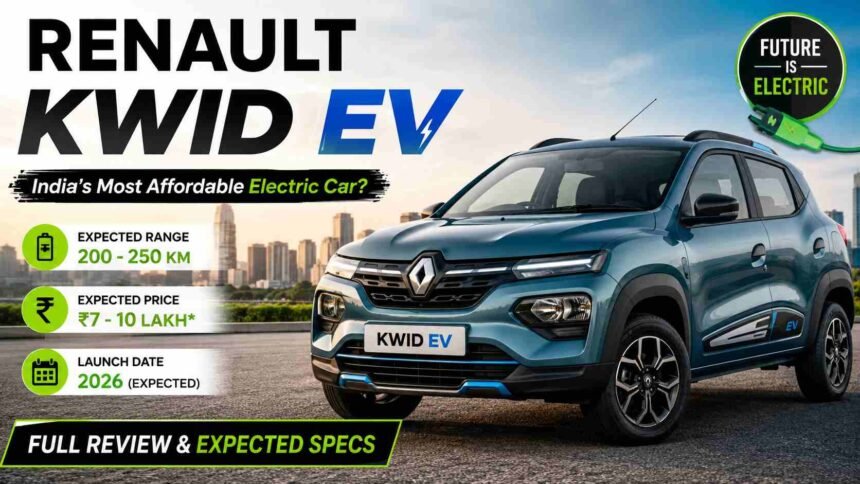
Electric cars are becoming more popular in India, but affordable options are still limited. Most electric cars cost considerably more than their petrol-powered versions, making them difficult to purchase for many first-time buyers. The upcoming Renault Kwid EV could change this situation.
The Renault Kwid EV is expected to be a small, practical, and budget-friendly electric hatchback developed mainly for city driving. It is likely to be based on the Dacia Spring, an electric city car already available in international markets.
Renault has not officially announced the final India-spec battery, features, price, or launch date. However, test vehicles and international models give us a good idea of what the upcoming electric Kwid may offer. Reports suggest that it could arrive in India during 2026 or later, although Renault has not confirmed a fixed timeline.
Let us take a detailed look at its expected specifications, driving range, design, features, price, and overall value.
Renault Kwid EV Exterior Design
The Renault Kwid EV is expected to maintain the compact and SUV-inspired character of the regular Kwid. However, its styling will likely be more modern and futuristic.
At the front, it may receive slim LED daytime running lights, a closed grille, a redesigned bumper, and a charging port positioned behind the Renault logo or front panel. Since an electric car does not require the same airflow as a petrol car, the grille area is expected to look cleaner.
The side profile could feature squared wheel arches, black body cladding, roof rails, and aerodynamically designed wheels. These elements may give the small hatchback a stronger road presence without making it difficult to drive through crowded streets.
At the rear, the car is expected to get stylish LED tail lamps, a new bumper, a roof-mounted spoiler, and Renault lettering across the boot lid.
Its compact dimensions should make parking easy, especially in busy cities such as Delhi, Mumbai, Bengaluru, and Pune. The regular Kwid already offers an SUV-inspired design and 184 mm of ground clearance, although the EV version’s final ground-clearance figure has not been announced.
Renault Kwid EV Interior and Cabin
The interior of the Renault Kwid EV is expected to be simple, practical, and suitable for daily use.
Its dashboard could be inspired by the latest Dacia Spring sold overseas. A floating touchscreen infotainment system may take centre stage, while a digital instrument display could show speed, battery percentage, remaining range, and charging information.
The car may officially be positioned as a four-seater or compact five-seater, depending on Renault’s India-specific configuration. Rear-seat space is likely to be suitable for children and average-sized adults, but three adults may feel uncomfortable during long journeys.
Renault Kwid EV Expected Features
Renault may offer enough features to attract young buyers and small families. The expected equipment list could include:
- Touchscreen infotainment system
- Wireless Android Auto and Apple CarPlay
- Digital instrument cluster
- Automatic climate control
- Steering-mounted controls
- Power windows
- Electrically adjustable mirrors
- Keyless entry
- Rear parking sensors
- Reverse parking camera
- USB charging ports
- Connected-car technology
Premium variants may also get wireless phone charging, cruise control, multiple driving modes, and remote vehicle functions through a mobile application.
The final equipment list will depend heavily on the Kwid electric price. Renault may offer different battery and feature combinations to keep the entry-level variant affordable.
Renault Kwid EV Battery and Motor
The Renault Kwid EV is expected to use a compact lithium-ion battery pack. Its international sibling has been offered with battery capacities of around 24.3 kWh to 26.8 kWh, depending on the version and market.
The India-spec vehicle could receive a similar battery or a locally adapted unit. Renault may also introduce more than one variant, allowing buyers to choose between a lower-priced city model and a more powerful version.
The latest international Dacia Spring Electric 70 uses a 52 kW motor, producing approximately 71 PS and 137 Nm of torque. It has a claimed top speed of around 125 km/h. These figures should only be treated as a reference because Renault may use a different motor setup for India.
Renault Kwid EV Range
Range will be one of the most important factors for Indian customers.
The expected Renault Kwid EV range could be between 200 km and 250 km on a full charge under certified test conditions. Real-world range may remain between approximately 150 km and 210 km, depending on traffic, weather, air-conditioner usage, speed, and driving style.
Some international versions of the Dacia Spring offer a claimed WLTP range of around 220 km, while independent estimates vary according to driving conditions.
For a person travelling 30 km to 50 km daily, the car may only need charging two or three times a week. This makes it suitable for office travel, school runs, shopping, and regular city errands.
Must Read: Best Cars Under 5 Lakh in India: Top 5 Lakh Cars
Charging Time and Options
The Renault Kwid EV is expected to support standard AC charging at home. Buyers may be able to charge it overnight using a regular power socket or a dedicated wall box.
Charging times could be approximately:
- Standard home socket: 10 to 13 hours
- AC wall box: 4 to 6 hours
- DC fast charger: 20 to 80 percent in around 40 to 50 minutes
These figures are based on the international Dacia Spring and may change for the India-spec model. Dacia states that some versions can take about 13 hours through a basic domestic connection, while faster home and DC charging options reduce the waiting time.
Renault may offer a home charger with the car or sell it as an optional accessory.
Renault Kwid EV Driving Experience
The Renault Kwid EV should feel most comfortable inside the city. Its small size, light steering, compact turning circle, and instant torque could make it easy to drive in heavy traffic.
The battery is usually placed below the cabin floor in an electric vehicle, which can create a low centre of gravity. This may improve stability compared with a lightweight petrol hatchback.
The cabin should also remain quieter than the petrol Kwid because there will be no engine noise or gearbox vibration.
Safety Features
Safety has become a major priority for Indian car buyers. The Renault Kwid EV may offer six airbags in higher variants, along with essential safety equipment such as:
- Anti-lock braking system
- Electronic brake-force distribution
- Electronic stability control
- Hill-start assist
- Tyre-pressure monitoring system
- Rear parking sensors
- Seat-belt reminders
- ISOFIX child-seat mounts
Battery protection will also be critical. The vehicle is expected to receive a reinforced battery casing, water-resistant electrical components, and systems that monitor battery temperature and voltage.
Kwid Electric Price in India
The expected Kwid electric price could start at around ₹7 lakh and go up to ₹10 lakh, ex-showroom. Different automotive publications currently provide wider estimates, with some expecting an ₹8 lakh to ₹11 lakh price range. Renault has not announced official pricing.
A starting price close to ₹7 lakh would make the car highly attractive. It could compete directly with the MG Comet EV and lower variants of the Tata Tiago EV.
Renault Kwid EV Launch Date
The Renault Kwid EV launch date has not been officially confirmed.
The car has been spotted testing, and several reports previously suggested a possible launch during 2026. Other estimates now point towards a later introduction, possibly in 2027. Renault has remained silent about the final India launch schedule, so any exact date published online should be treated as speculative.
Renault may first reveal the production-ready model, followed by an official price announcement and deliveries.
Renault Kwid EV Rivals
The Renault Kwid EV is likely to compete with:
- MG Comet EV
- Tata Tiago EV
- Citroën eC3
- Tata Punch EV
- Upcoming affordable electric hatchbacks
The MG Comet EV is compact and easy to drive, while the Tata Tiago EV offers more space and a familiar hatchback design. The Renault will need an aggressive price, useful real-world range, dependable after-sales support, and good safety features to stand apart.
Pros and Cons
Expected Advantages
The Renault Kwid EV could offer an affordable purchase price, low running cost, compact dimensions, easy city driving, practical range, and modern styling. Its familiar Kwid identity may also help buyers feel more confident about choosing an electric vehicle.
Possible Disadvantages
Rear-seat space may be limited, highway performance could be modest, and charging infrastructure remains inconsistent in several parts of India. The cabin may also use basic materials to keep the price under control.
Renault Kwid EV: The Bottom Line
The Renault Kwid EV has the potential to become an important entry-level electric car in India. It may not offer luxury features, extreme performance, or a massive battery. Instead, its biggest strength could be simple and affordable urban mobility.
A real-world range of around 180 km, competitive features, dependable battery warranty, and a starting price near ₹7 lakh could make it a powerful choice for first-time EV buyers.
However, the final decision should depend on Renault’s official specifications, crash-safety package, charging support, and on-road price. Until those details are confirmed, the car remains a promising upcoming model rather than a proven recommendation.
For city users who want lower running costs and easy everyday driving, the Renault Kwid EV could be worth waiting for.