



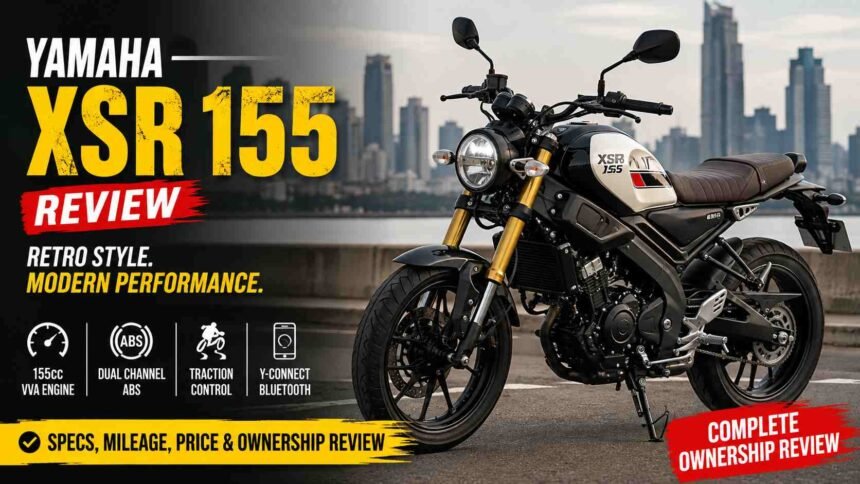
The Yamaha XSR 155 is one of the most exciting modern-retro motorcycles in the Indian market. It combines the timeless appearance of a classic roadster with the advanced engine and chassis technology found in Yamaha’s popular performance bikes.
Launched in India in November 2025, the motorcycle entered the market at around ex-showroom price ₹1.49 lakh ex-showroom. Yamaha later revised its pricing and added more colour choices. Buyers should therefore confirm the latest on-road price in India with their nearest dealership before booking.
Unlike many retro-looking motorcycles that focus mainly on design, the Yamaha XSR 155 also offers strong performance, lightweight handling and useful safety features. But is it comfortable and practical enough for daily ownership?
Let us take a detailed look at its design, performance, mileage, comfort, maintenance and overall ownership experience.
Yamaha XSR155 Design and Road Presence
The biggest attraction of the Yamaha XSR 155 is its beautiful neo-retro design. It has a round LED headlamp, a sculpted fuel tank, a flat-style seat and a compact tail section.
Its simple horizontal body design gives it the appearance of an old-school motorcycle, while details such as LED lighting, upside-down front forks and alloy wheels make it look modern.
The exposed frame and muscular fuel tank provide a strong road presence without making the bike look too heavy. It feels more premium and distinctive than a regular commuter motorcycle.
The round digital instrument cluster also suits the overall theme. It displays important information such as speed, engine rpm, fuel level and fuel-consumption data. Yamaha has also equipped the Indian model with smartphone connectivity through Y-Connect.
For riders who want a stylish bike that stands apart from common street motorcycles, the design is one of the strongest reasons to consider it.
Engine and Performance
The Yamaha XSR 155 is powered by a 155cc, liquid-cooled, single-cylinder engine with fuel injection and Variable Valve Actuation technology.
This engine produces 18.4 PS of maximum power at 10,000 rpm and 14.2 Nm of torque at 7,500 rpm. It is connected to a six-speed gearbox.
The engine is closely related to the proven motor used in Yamaha’s R15 and MT-15 platforms. It offers smooth low-speed performance and becomes noticeably more energetic as the engine speed increases.
In city traffic, the bike feels responsive and easy to control. The first few gears offer enough acceleration for quick overtakes, while the higher gears make highway riding relaxed.
The VVA system helps the engine deliver usable performance at lower speeds without losing its sporty character at higher rpm. Riders who enjoy revving the engine will appreciate its lively nature.
It may not provide the strong low-end pull of a larger 250cc or 350cc motorcycle, but its lightweight body allows it to feel quick and entertaining.
City Riding Experience
The Yamaha XSR 155 is well suited to daily city riding. Its narrow body, upright handlebar and 137 kg kerb weight make it easy to manage in crowded traffic.
Changing lanes and passing through small traffic gaps does not require much effort. The clutch action is manageable, and the six-speed transmission offers smooth gear changes.
The engine can handle slow traffic, although frequent gear changes may be required when riding at very low speeds. This is because the motor delivers its strongest performance higher in the rpm range.
The liquid-cooling system is helpful during long rides and stop-and-go traffic. However, riders may still notice some engine heat around their legs during slow summer traffic, which is normal for a performance-focused liquid-cooled motorcycle.
Overall, it is easy enough for regular commuting while remaining far more enjoyable than an ordinary commuter bike.
Highway and Touring Performance
On highways, the Yamaha XSR 155 feels stable and confident. The Deltabox frame provides good control around corners, while the wide rear tyre improves grip.
The motorcycle can comfortably maintain normal highway speeds, and there is enough power available for overtaking. The six-speed gearbox helps the engine remain smooth during longer rides.
However, the motorcycle does not come with a windscreen. Riders may experience wind pressure at higher speeds, especially during long highway journeys on Yamaha bikes like the XSR 155.
Its 10-litre fuel tank is also slightly small for serious touring. Depending on riding conditions and mileage, owners may need to plan fuel stops more frequently than they would on a larger touring motorcycle.
The bike is capable of weekend touring, but adding a small windscreen, luggage rack or soft saddlebag system could make it more practical.
Must Read: Yamaha RX 100 New Model: Expected Price, Specs, Features & Relaunch
Mileage and Fuel Expenses
Mileage is an important part of the ownership experience, especially for Indian buyers.
Real-world fuel efficiency depends on traffic, riding speed, tyre pressure and riding style. Industry listings report owner mileage in the region of 45 kmpl, while calm highway riding may produce slightly better figures.
Aggressive riding and frequent high-rpm acceleration will reduce fuel efficiency. Owners using the motorcycle mainly for daily office travel can reasonably expect competitive mileage for a performance-oriented 155cc engine.
Its combination of usable performance and economical fuel consumption makes it suitable for riders who want excitement without the high running costs of a larger-capacity bike.
Ride Quality and Handling
The Yamaha XSR 155 uses 37mm upside-down front forks and a link-type rear monoshock. It also gets a lightweight Deltabox frame.
The suspension setup gives the bike sharp and controlled handling. It feels planted around corners and reacts quickly to steering inputs.
This sporty setup may feel slightly firm on broken roads, deep potholes and poorly maintained city streets. Riders travelling regularly over rough surfaces should take a proper test ride before making a decision.
The 170mm unladen ground clearance is useful for most Indian roads and speed breakers. Yamaha notes that the laden clearance is lower when the rider and pillion are onboard, so extra care may be needed over unusually large speed breakers.
Braking and Safety Features
The motorcycle comes with a 282mm front disc and a 220mm rear disc. Dual-channel ABS is offered as standard.
It also receives traction control, which reduces the possibility of rear-wheel spin on slippery or loose surfaces. This is a valuable addition for riding during rain or on roads covered with gravel.
Braking performance should be strong enough for both city and highway use. Dual-channel ABS adds greater confidence during sudden braking and makes the bike more suitable for new or less experienced riders.
The combination of ABS, traction control and wide tubeless tyres gives the Yamaha XSR 155 an impressive safety package for its category.
Rider and Pillion Comfort
The riding position is mostly upright, with a wide handlebar and slightly rear-set footpegs. It feels sporty without forcing the rider into an aggressive racing posture.
The seat height is 810mm. Shorter riders may initially find it tall, but the slim body and low kerb weight make the motorcycle easier to balance than the seat-height number suggests.
The rider’s section offers reasonable space for daily commuting and short touring rides. However, the firm suspension and compact seat may become tiring after several hours.
Pillion comfort is acceptable for short city journeys, but it may not be ideal for long-distance travel. The rear seating area is not as spacious as that of a dedicated family motorcycle.
Owners who frequently ride with a pillion should check seat comfort during a showroom test ride.
Maintenance and Long-Term Ownership
The Yamaha XSR 155 uses an engine platform that is already familiar in India, similar to the Yamaha R15. This should make routine servicing and mechanical support easier through Yamaha’s authorised service network.
Regular expenses will include engine oil, filters, chain cleaning, chain lubrication, brake pads and periodic coolant replacement. Its liquid-cooled engine and premium components may make servicing slightly more expensive than a basic 125cc commuter motorcycle, similar to the costs associated with the Royal Enfield Hunter 350, but the Yamaha XSR 155’s specifications justify the investment.
Replacement parts such as the wide rear tyre, upside-down fork components and body panels may also cost more than parts for entry-level bikes.
Owners should follow Yamaha’s recommended service intervals, maintain correct tyre pressure and lubricate the chain regularly. Proper maintenance will help preserve performance, mileage and gearbox smoothness.
Service quality can vary between dealerships, so choosing a reliable authorised service centre remains important.
Advantages of the Yamaha XSR 155
The motorcycle offers a rare combination of retro styling and sporty performance. Its engine is powerful for the segment, and its lightweight chassis makes everyday riding enjoyable, making it a competitive choice against the Hunter 350.
It also gets important premium features such as dual-channel ABS, traction control, LED lighting, upside-down forks, smartphone connectivity and VVA technology.
The bike is particularly appealing to riders who want the performance of a modern Yamaha but prefer classic styling over the aggressive appearance of a streetfighter or sports bike.
Areas That Could Be Better
The firm suspension may not suit riders who regularly travel on poor roads. Pillion comfort is also average, especially for long rides.
Its 10-litre fuel tank limits touring range, and the 810mm seat may feel tall for some riders, especially when compared to the Royal Enfield Hunter 350, but the Yamaha XSR 155’s performance compensates for it. The bike is also more expensive than many conventional 155 cc and 160cc motorcycles, including the Yamaha XSR 155 price range.
Buyers primarily looking for maximum comfort, strong low-end torque, or family practicality may find alternatives such as the TVS Ronin or heavier retro motorcycles like the Royal Enfield Hunter 350 more suitable.
Yamaha XSR 155 Review: The Bottom Line
The Yamaha XSR 155 is a stylish, quick and feature-rich motorcycle with genuine everyday usability. It successfully combines classic design with a modern engine, advanced safety equipment and sharp handling.
It is a strong choice for young riders, working professionals and motorcycle enthusiasts in 2026 who want something more distinctive than a regular commuter bike.
The motorcycle is not perfect. Its firm ride, compact pillion seat, and limited fuel-tank capacity may concern some buyers, particularly those considering the Yamaha XSR 155’s road price. However, these drawbacks are balanced by its exciting performance, manageable weight, impressive mileage and premium technology.
For riders who value style, handling and engine refinement, the Yamaha XSR 155 can be a rewarding long-term companion, as reflected in user reviews. A detailed test ride is recommended, particularly to check seat height, suspension comfort and pillion space before purchase.