



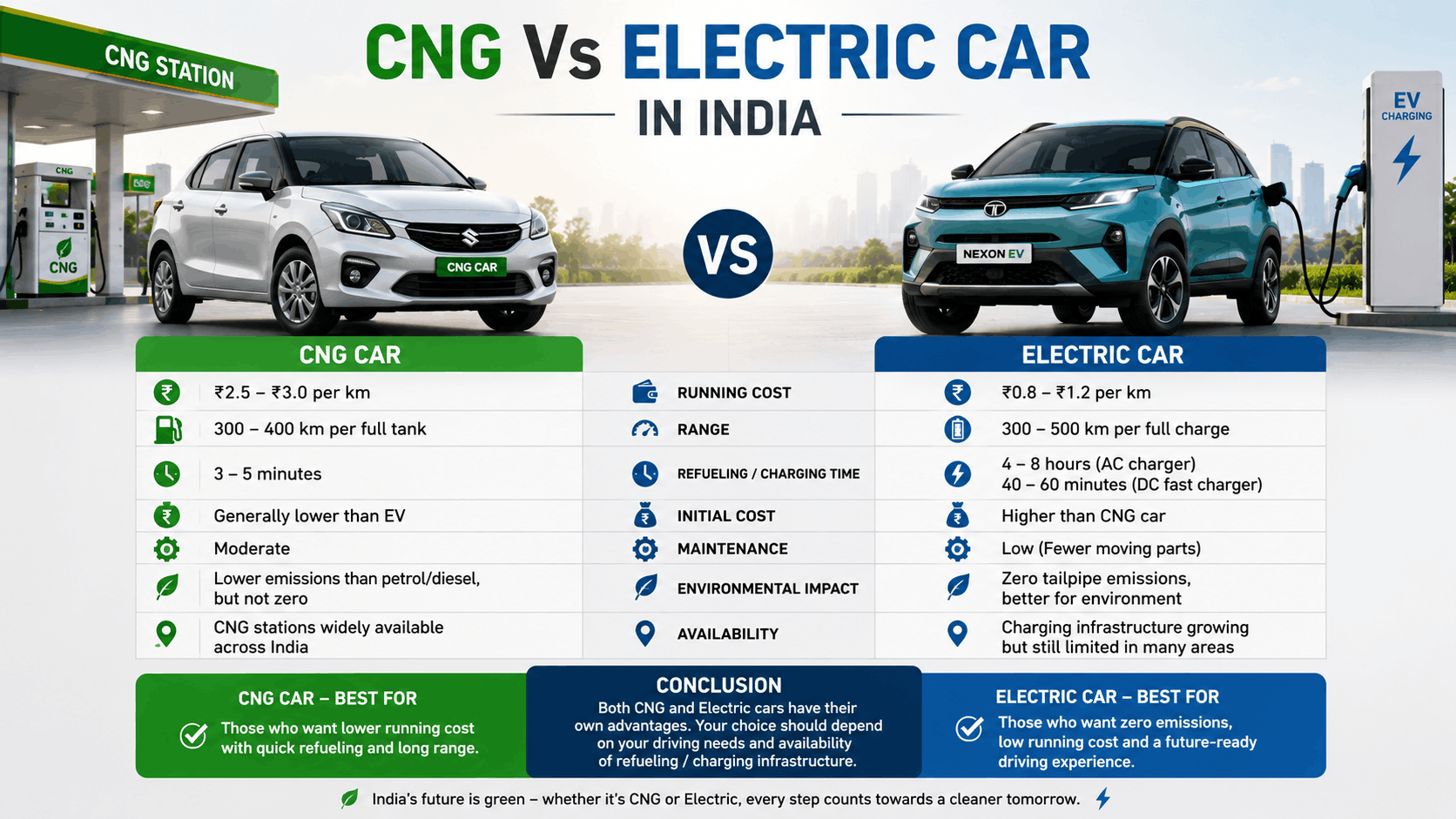
Buying a new car in India has become more confusing than ever. Petrol and diesel prices are high, while new technologies like CNG and Electric Vehicles (EVs) are becoming more popular every year. Many buyers now ask the same question: CNG Vs Electric Car – which one is the better option?
Both options help you save money on fuel, but they are designed for different driving needs. A CNG car offers lower running costs with the convenience of a petrol engine, while an electric car promises zero tailpipe emissions and advanced technology.
In this blog, we will compare CNG vs Electric cars India in terms of price, mileage, charging, maintenance, performance, and long-term ownership cost.
Understanding CNG Cars
A CNG (Compressed Natural Gas) car uses natural gas as its primary fuel. Most factory-fitted CNG cars also come with a petrol fuel tank, allowing drivers to switch between petrol and CNG whenever needed.
Advantages of CNG Cars
- Lower fuel cost
- Dual-fuel convenience
- Large refuelling network in major cities
- Lower emissions than petrol and diesel
- Ideal for daily office commuting
Disadvantages
- Lower boot space because of the gas cylinder
- Slightly less engine power
- Long waiting time at some CNG stations
- Limited availability in rural areas
Understanding Electric Cars
Electric cars run entirely on battery power. Instead of filling fuel, they are charged using home chargers or public charging stations.Electric vehicles have become increasingly popular because of government support, lower running costs, and better battery technology.
Advantages of Electric Cars
- Zero tailpipe emissions
- Extremely low running cost
- Smooth and silent driving experience
- Instant acceleration
- Lower maintenance expenses
Disadvantages
- Higher purchase price
- Charging infrastructure is still in developing phase
- Longer charging time compared to fuel filling
- Battery replacement is expensive after many years
CNG Vs Electric Car: Detailed Comparison
1. Purchase Price
One of the biggest differences is the initial cost. A factory-fitted CNG car usually costs around ₹80,000 to ₹1.5 lakh more than its petrol version. Electric cars generally cost ₹3 lakh to ₹8 lakh more than similar petrol hatchbacks.
Winner: CNG Vehicles
2. Running Cost
Running cost is where both options shine.
Average running cost:
- Petrol: ₹7–9 per km
- Diesel: ₹5–7 per km
- CNG: ₹2.5–3.5 per km
- Electric: ₹1–1.5 per km
Electric cars clearly offer the lowest daily running cost.
Winner: Electric Vehicles
3. Mileage Cost
When comparing mileage cost, electric vehicles are difficult to beat. A full battery charge usually provides 250–500 km depending on the model. While CNG cars generally offer 25–35 km per kg.
Although CNG is economical, electricity remains cheaper per kilometre in most cities.
Winner: Electric Vehicles
4. Refuelling vs Charging
This is where CNG still has an advantage. Refilling a CNG tank takes only a few minutes.
Charging an electric vehicle may take:
- 6–8 hours using a home charger
- 45–60 minutes using a fast charger
If you frequently travel long distances, charging can require better trip planning.
Winner: CNG Vehicles
5. Maintenance
Electric cars have fewer moving parts.
There is:
- No engine oil
- No clutch
- No gearbox
- No exhaust system
This means lower servicing costs.
CNG cars still require regular engine maintenance similar to petrol cars.
Winner: Electric Vehicles
6. Performance
Electric cars deliver instant torque. Acceleration is quick and smooth, especially in city traffic.
CNG cars lose around 8–12% engine power compared to petrol mode. Drivers looking for exciting performance will enjoy EVs more.
Winner: Electric Vehicles
7. Driving Range
CNG cars can switch to petrol after the CNG tank becomes empty. This increases total driving range significantly.
Electric cars depend completely on battery charge.
Although modern EVs offer impressive range, charging stations may not always be available.
Winner: CNG Vehicles
8. Environmental Impact
Electric vehicles produce zero tailpipe emissions. CNG also burns cleaner than petrol and diesel but still emits carbon dioxide.
For eco-conscious buyers, EVs are the greener choice.
Winner: Electric Vehicles
Must Read: E20 Petrol Explained: Is It Safe for Your Car and Bike? Complete Guide 2026
Budget Cars Comparison
If your budget is under ₹10 lakh, CNG cars currently offer more choices.
Popular CNG options include:
- Maruti Suzuki WagonR CNG
- Tata Tiago CNG
- Maruti Swift CNG
- Hyundai Grand i10 NIOS CNG
Affordable electric cars include:
For buyers with a limited budget, CNG remains the more affordable option.
Who Should Buy a CNG Car?
Choose a CNG car if you:
- Drive over 50 km daily
- Frequently travel on highways
- Need quick refuelling
- Have a limited budget
- Want lower running costs without charging concerns
Who Should Buy an Electric Car?
Choose an electric car if you:
- Mostly drive within the city
- Have home charging available
- Want the lowest running cost
- Prefer modern technology
- Care about reducing pollution
CNG Vs Electric Cars India: Quick Comparison Table
| Feature | CNG Car | Electric Car |
|---|---|---|
| Purchase Price | Lower | Higher |
| Running Cost | Low | Lowest |
| Maintenance | Medium | Low |
| Performance | Good | Excellent |
| Refuelling Time | 3–5 Minutes | 45 Minutes to 8 Hours |
| Range | Higher | Moderate |
| Pollution | Low | Zero Tailpipe Emissions |
| Best For | Highway & Daily Users | City Commuters |
Final Verdict
The debate between CNG Vs Electric Car depends entirely on your driving needs.
If you want a budget-friendly car with excellent fuel savings and the flexibility of petrol backup, a CNG car is still one of the smartest choices in India.
However, if your daily driving is mostly within the city and you can install a home charger, an electric car offers the lowest running cost, smoother performance, and a cleaner driving experience.
In the growing market of CNG vs Electric cars India, both technologies have their strengths. Your budget, daily mileage, and charging or refuelling convenience should be the deciding factors.
Instead of asking which technology is universally better, ask which one suits your lifestyle. That answer will help you make the best investment for years to come.